Category: Healing music

Subscribe here to receive the next post in your inbox.

  • Inside Out

    First, I tuned the guitar away from standard pitch until it really started to sing. Then I recorded this melody. Can you hear the way the instrument resonates and “sings” behind the main melody notes? I think it’s a good metaphor for what happens to us in those times when we feel in harmony with our experience.

    Here are some notes on the recording:

    • This guitar tuning can be achieved by setting a tuner to a reference pitch of 448Hz or 423Hz. If using 448Hz, tune the guitar down a whole step, and for 423Hz, tune down a half step.
    • This melody was adapted from the song “Tired”

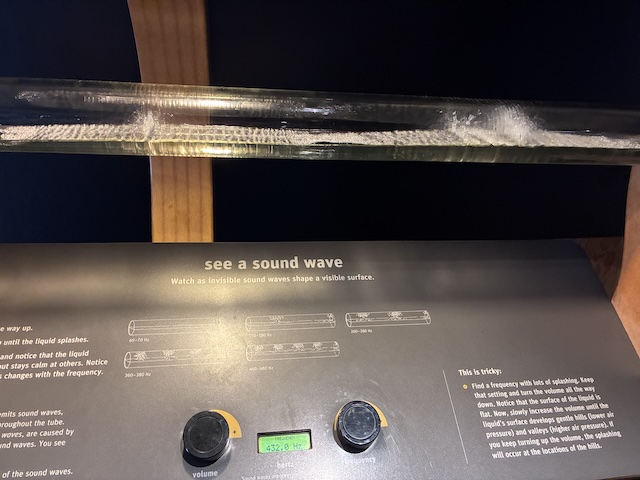
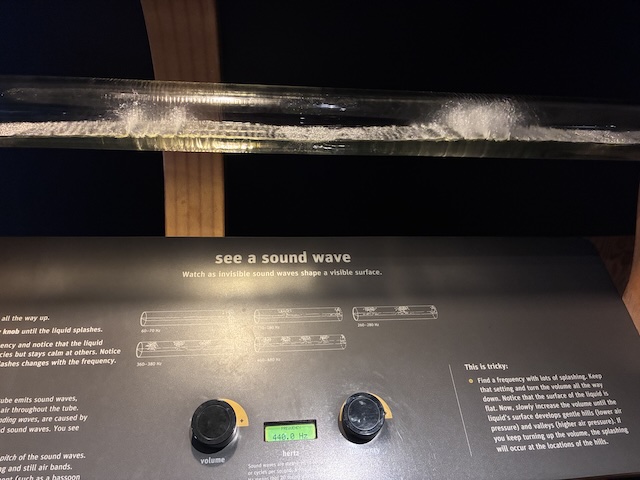
    Last week my family visited one of the premier science museums in the country: the Exploratorium in San Francisco. While there, I noticed a device that helps visualize harmonics by playing an adjustable tone into a tube full of water. After finishing the recent blog series on alternate tunings, I couldn’t help but go straight for 440Hz and 432Hz. Here are the visuals for each:

    432Hz visualized
    440Hz visualized

    In my rush I failed to get a photo of some really different patterns, but these two were almost identical to me. This didn’t add any evidence for me to change my conclusion that music released in 432Hz isn’t magically better that 440Hz. But the slight difference in the visual waves does support that the harmonics do subtly change, and therefore so does the overall sound of the instrument.

    May your week be in-tune,
    –Alex

  • Where Old Lentils Go to Die

    For the fourth and final post in this series on alternative tunings, I present to you a magical tuning guaranteed to (maybe) make your dreams come true. I call it LexTune*, and you can listen to a song played in this tuning here:

    Okay, I admit it, I’m being cheeky. I can’t guarantee anything about what listening to a song in this tuning will bring you. My summary on songs in alternative tuning begins with this point: neither, do I believe, can the composers of the “Crystal Whale Sunset Healing 432hz Abundance Vibration” music.

    To summarize what claims you might find online about alternative tunings such as 432Hz:

    • 432 has nicer mathematical properties than 440
    • The number 432 can supposedly be derived by applying mathematical transformations to the natural rate of vibration of the Earth
    • Some ancient instruments were maybe tuned to 432Hz

    I wanted to go on a journey exploring 432Hz vs 440Hz over the past few weeks. Here’s a summary of the feedback I got about the different tuning experiments, carried out on guitar and synthesizer:

    For the guitar tracks played in the It’s All Vibration, More or Less post, I got a number of emails where people expressed a preference for one or the other.

    For the purely synthesized tracks played in the Voices From The Void post, the feedback I received was that the two were too similar to discern. And notably, no one commented that they preferred one to the other.

    This supports the hypothesis I put forth in the post entitled The Tires and The Bicycle, that the differences in tuning are inconsequential, but the changes in the tone of an acoustic instrument are much more noticeable.

    That’s the crux of it. To follow, I’ll add some additional information on why I don’t believe the claims that 432Hz is somehow magical…

    The most compelling argument to me is that classical Indian music, which is an ancient system, (and I think one of the most mystical systems of music on the planet) does not prescribe any particular tuning system. I had the fortune of studying at the Ali Akbar College of Music for a summer in the mid-1990’s. During a performance, the lead musician tuned their instrument to their liking (never using a tuner) and the supporting musicians tuned to match. If there was a vocal performer, the musicians tune to accommodate the range of the singer, using their voice as the standard of tuning, not an electric tuner.

    Similarly, the instruments of a Javanese Gamelan orchestra, which is another ancient musical system, are tuned to the ear of the instrument maker. Each of the instruments in the orchestra are tuned to each other, but can’t be used to play with the instruments of another orchestra, for they would be out of tune!

    *to get LexTune, I loosened my guitar strings, and then brought them back up to a pitch that I thought made the guitar I was playing sound extra nice. No numerical measurement involved, although I did verify it’s not in the standard 440Hz tuning. I thought it sounded great. Feel free to let me know if you like the sound of it.

    Finally, why in the world did I name this post “Where Old Lentils Go to Die”? Because it evokes a story from my life when I something I was told, and believed to be true, was so thoroughly debunked by an experience, that it added to the erosion of my ability to blindly accept untested truths.

    The story goes like this:

    I lived in Hawaii in 2002. I was in the rainforest on the Big Island. It was a time of there being a critical mass of “conscious community” in that part of the island. Diet was a frequent subject of conversation. There were entire communities organized around dietary choices. There was a “raw foodist” commune where I would sometimes go to attend events. I became familiar with some of the claims around that diet. I occasionally wondered if I was somehow failing to live up to my health potential due to eating “dead” cooked food?

    Well, one day after putting some extremely well cooked lentils in the refrigerator, I encountered them again a couple days later, still in the refrigerator, and they all had the little sprout tails sticking out! It was at that exact moment that I dropped all negative illusions of cooked food being dead.

    May this post bring you some tools to further evaluate claims around alternate tuning systems, should you ever encounter them.

    This article is part of a series:

    1. It’s All Vibration, More or Less
    2. The Tires and The Bicycle
    3. Voices From The Void
    4. Where Old Lentils Go to Die

  • Voices From The Void

    This week, I’m presenting a musical theme played in two different tunings, but this time all the sounds were generated by an electronic synthesizer. There is no physical instrument “resonating” to add to the tonal differences in the notes.

    A couple weeks ago, I shared two guitar recordings of the same musical theme, played in two different tunings: 440Hz and 432Hz. Check that out if you’d like background on the conversation about tunings.

    Last week I was discussing how the same music in 2 different tunings, when played on an instrument like a guitar, can not be compared as apples-to-apples. If you’ve ever sung in a resonant place (such as in the shower), you know that there are certain notes in certain spaces that resonate louder than other notes. This is the relationship of the sound vibrations to the space in which they’re bouncing around. The guitar itself is a resonator. Certain tones will “sing” louder than others, and when changing the tuning of the strings, it will change the way the instrument resonates. And that adds to the difference in the sounds between each tuning.

    I invite you to listen to each version of the synthesized music above, and let your body tell you which one you prefer. This is an exploration of the right music, right now, for you. There is no right or wrong answer to which one you like better.

    Wishing you a week in tune,
    –Alex

    This article is part of a series:

    1. It’s All Vibration, More or Less
    2. The Tires and The Bicycle
    3. Voices From The Void
    4. Where Old Lentils Go to Die
  • The Tires And The Bicycle

    Last week, I presented the same music played in two different styles of tuning: 440Hz and 432Hz.

    One thing to consider is that changing the tuning on a guitar is like raising or lowering the pressure on the tires of a bicycle. You can’t only change the amount of air in the bike tires, without affecting the way the bike handles, and the frame vibrates.

    Similarly, “only” changing the tuning on the guitar also changes the way the wood and strings vibrate. It fundamentally changes the quality of the tone. So, it’s not apples to apples when deciding if you like one tuning vs the other.

    Next week, I’ll present another set of music played in two different tuning systems, but this time I won’t play an acoustic instrument. I’ll use a synthesizer to generate the tones, thus it won’t be subject to the variations that come from how the instrument vibrates. It will just be generated tones that are slightly higher, or lower.

    Stay tuned

    This article is part of a series:

    1. It’s All Vibration, More or Less
    2. The Tires and The Bicycle
    3. Voices From The Void
    4. Where Old Lentils Go to Die
  • It’s All Vibration, More Or Less

    We rely on being able to plug something into a home outlet and not fry it with too much voltage. Similarly, two musicians who “tune” their instruments independently expect to be able to play together and have it sound good. This is due to the — mostly invisible — “standards” that people rely on, whether electrical, musical, or otherwise.

    Pressing the “A” key in the middle of a piano keyboard delivers a note that vibrates 440 times per second; also known as 440 Hertz. A guitar player, using a tuner, orients the instrument around the same tuning.

    However… if you search for “healing music” online, you will very quickly come across music that has various numbers like “432 Hz” in the title. This means that the song was performed by a musician who diverged from the “standard” way of tuning, and instead of 440 vibrations per second on that “middle A” note, tuned slightly lower, vibrating 432 times per second. It can be subtle, unless two musicians using different tuning standards try to play together. In that case it would sound obviously “out of tune”. But if everyone has tuned to the same standard, it will sound fine.

    The types of music you will find in the alternately tuned healing music often comes with intriguing titles along the lines of “Crystal Whale Sunset Healing 432hz Abundance Vibration”. You may start to pick up that people releasing music in alternate tunings are suggesting that there is something “there” for you, that’s not available in “standard” (440 Hz) tuning.

    Is that true? Today I’m going to do 2 similar improvisations, played with the guitar tuned at 440 Hz, and then at 432 Hz. Do you like one more than the other? Does one feel more “healing”?

    In my view, healing music is a combination of the sound, the performer, and the listener. The right music, for the right person, at the right time is your healing music. So, perhaps it’s worth seeking out some music in alternate tunings. But I think it’s best not to believe something is good for you because someone said it should be, but to decide based on your experience, your truth.

    Fair warning: which ever one you listen to first will become your ear’s “reference pitch”, and the other recording will likely sound out of tune. You might need some time between listening to the first and second recordings.

    Here is the 440 Hz recording:

    Here is the 432 Hz recording:

    To your health,
    –Alex

    This article is part of a series:

    1. It’s All Vibration, More or Less
    2. The Tires and The Bicycle
    3. Voices From The Void
    4. Where Old Lentils Go to Die

  • Step By Step

    Happy tunes-day. This week I was playing around with small changes within rhythmic regularity. An audible exploration of how we can get from here to there, with small steps in between.

  • Easy

    This song helped me remember that easy is sometimes the answer.

  • Joy Of Missing Out

    How do we make the space to tap into our own capacity to heal? This is a song in celebration of JOMO, or the “Joy Of Missing Out”.

  • Lion’s, Tigers, or Bears…

    … are examples of encounters that merit doing more, and going faster.

    More, faster, is in general not in the interest of healing.

    When we hitch ourselves to the train, literally entrain to, popular culture that’s the direction in which we’ll be pulled.

    Here is a slow song you can hitch to. Slowing down, doing less, and remembering to breathe usually lead us in the direction of healing.

  • Ocean Mother

    We never left the ocean. We just took it with us. Our blood, the fluid in our cells, the amniotic sea.

    Sanity and comfort available outside of ourselves feels in short supply. Let’s re-hydrate with help from this song to bring us to this source. Mediterranean sea waves cradle a gently churning eddy of electric guitar notes:

    May this bring you comfort and peace,
    – Alex


    New Music Releases:

    Music Of Dreams (cover art by Julia Rosenberg!)

    Compiled from 4 songs I shared during the recent sleepy winter months

    spotify
    apple music
    amazon music
    or any streaming platform search “Your Music For Healing”

    Pachamama, I’m Coming Home

    The song I sung to my friend before she took flight from this earth

    spotify
    apple music
    amazon music
    or any streaming platform search “Your Music For Healing”

    Feeling Rumi Vibrations (cover art by Julia Rosenberg!)

    Shared here a couple weeks ago

    spotify
    apple music
    amazon music
    or any streaming platform search “Your Music For Healing”

    Good two’s-day to all!