Music Notes

Subscribe here to receive the next post in your inbox.

  • Let’s Trade Healing Songs

    Music is healing. I don’t know how often you think about it in those specific terms, but my guess is that you can think of a song or two that you might listen to if you’re in some kind of pain. What comes to mind?

    I’ll share one that comes to mind for me: “New Grass” by Talk Talk off of their 1991 release entitled “Laughing Stock”. I find the sense of space and sparse instrumentation both relaxing and transcendent.

    One of the things that I’ve puzzled over since starting this web site and blog is how to bridge the gap between what I do in a live setting and the music I share here. In a live setting, I get to track how the music is landing, and change it in the moment. In that sense, I truly get to play Your Music For Healing. When sharing my recordings here, I don’t have any live feedback to work with. Although I always base my recording process around starting with a healing intention, it’s kind of like sharing My Music That I Hope Is Healing For You.

    Even though I may never know exactly how a piece of pre-recorded music is landing with someone I can’t see, I’m bringing the same kind of listening into the recording process. I hold in mind an imagined listener who I might be playing for, and let my imagination of how the music might land with that listener affect how the songs are developed, played, edited, and mixed.

    Playing music that adjusts to meet the listener, live or imagined, is my favorite thing to do.

    Thank you for being on the other side,
    –Alex

  • River Eddy

    Sometimes music isn’t so much written as it is discovered. Like walking down a twisting pathway into a canyon, and finding peace alongside a lazy riverbank. That was the spirit with which I went into shaping this piece of music for you. May it provide a peaceful place for all of us to rest for a moment, before the river of the week sweeps us along again.

  • Perfect?

    I sat down under the redwood tree, blooming rose bushes in view, ready to record the sounds of pure inspiration. That’s when the loud truck pulled up to unload freight, and my youngest son came outside to flick objects around on his laps around the yard.

    For a moment I felt my paradise was being invaded, but then remembered, when is it ever different? Our perfect moments are always right here, interruptions and frustrations included.

    So I hit record anyway. Here’s the sound of perfectly interrupted inspiration:

    May your week be perfectly imperfect,
    –Alex

  • On The Train

    Last week’s entrainment sounds seemed to resonate with people. Here’s another longer background piece, set at the pace of a relaxed resting heartbeat. The tempo will resonate through your “nerve highway” that connects through many vital systems, including: brain, heart, digestive system.

    A peaceful week,
    –Alex

  • (If) You Need Rest

    …listen to this.

    As to why it works, it comes down to “entrainment”. There is a nerve “highway” that is stimulated by the ears, and connects brain, heart, and digestive system. Rhythm affects our bodies in profound ways, and can raise or lower our heart rate as our nervous system orients around the steady rhythm. The right sound at the right time can literally move us from “fight or flight” into “rest and digest”. I chose the rate of the rising and falling tones of this composition to match relaxed breathing.

    From my description on the song page, “Waves crash against the shore as a soothing drone cycles in the background at the rate of a full and relaxed breath.”

    I recommend listening at a low volume. It also makes a good background soundscape while concentrating on other tasks.

    A peaceful week,
    –Alex

  • Summertime Fades In

    … like a great live band playing across a field, getting more energetic with every step towards the music.

    In that spirit, I present this song:

  • Hearing Feeling

    I love to create feelings with sound, like a visual artist uses color to evoke mood.

    Here’s a track I recorded many years ago. It was a foggy February in Berkeley, and I was feeling very foggy inside as well. Does this track deliver a vibe for you?

  • Catharsis

    Sometimes less words is better.

    +

    A week of peace to you,
    –Alex

  • Inside Out

    First, I tuned the guitar away from standard pitch until it really started to sing. Then I recorded this melody. Can you hear the way the instrument resonates and “sings” behind the main melody notes? I think it’s a good metaphor for what happens to us in those times when we feel in harmony with our experience.

    Here are some notes on the recording:

    • This guitar tuning can be achieved by setting a tuner to a reference pitch of 448Hz or 423Hz. If using 448Hz, tune the guitar down a whole step, and for 423Hz, tune down a half step.
    • This melody was adapted from the song “Tired”

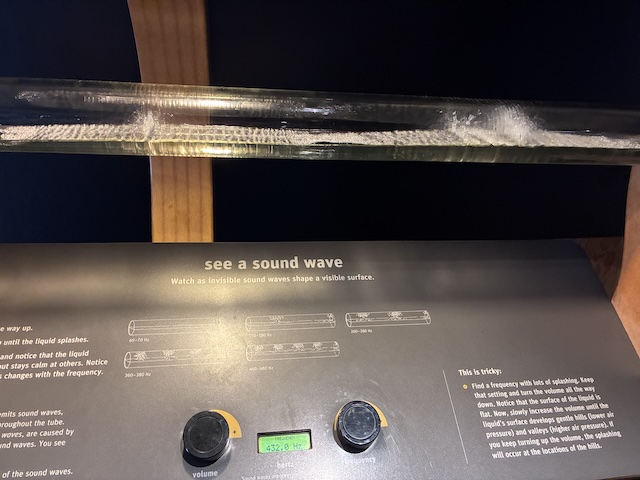
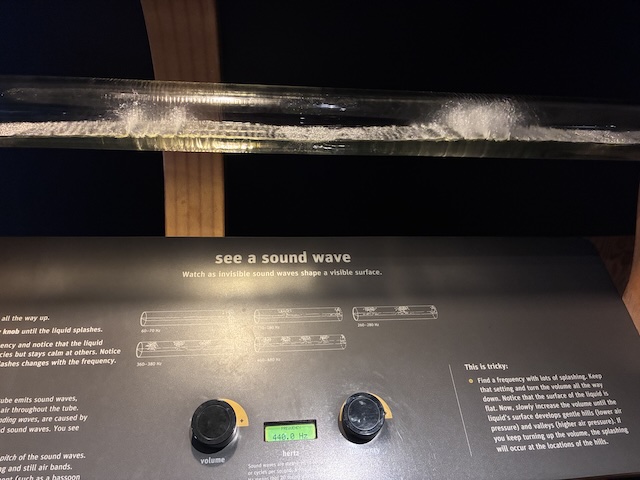
    Last week my family visited one of the premier science museums in the country: the Exploratorium in San Francisco. While there, I noticed a device that helps visualize harmonics by playing an adjustable tone into a tube full of water. After finishing the recent blog series on alternate tunings, I couldn’t help but go straight for 440Hz and 432Hz. Here are the visuals for each:

    432Hz visualized
    440Hz visualized

    In my rush I failed to get a photo of some really different patterns, but these two were almost identical to me. This didn’t add any evidence for me to change my conclusion that music released in 432Hz isn’t magically better that 440Hz. But the slight difference in the visual waves does support that the harmonics do subtly change, and therefore so does the overall sound of the instrument.

    May your week be in-tune,
    –Alex

  • Where Old Lentils Go to Die

    For the fourth and final post in this series on alternative tunings, I present to you a magical tuning guaranteed to (maybe) make your dreams come true. I call it LexTune, and you can listen to a song played in this tuning here:

    Okay, I admit it, I’m being cheeky. I can’t guarantee anything about what listening to a song in this tuning will bring you. Neither, do I believe, can the composers of the “Crystal Whale Sunset Healing 432hz Abundance Vibration” music guarantee you anything magical based on the tuning.

    To tune to LexTune on my instrument, I loosened my guitar strings, and then plucked the strings while tuning them back up to a pitch that I thought made the guitar sound extra nice. No numerical measurement involved, although I did verify it’s not in the standard 440Hz tuning.

    To summarize what claims you might find online about alternative tunings such as 432Hz:

    • 432 has nicer mathematical properties than 440
    • The number 432 can supposedly be derived by applying mathematical transformations to the natural rate of vibration of the Earth
    • Some ancient instruments were maybe tuned to 432Hz
    • Some composer in the past preferred their orchestra tune to a standard other than 440Hz

    We’ve been on a journey exploring 432Hz vs 440Hz over the past few posts. Here’s a summary of the feedback I got about the different tuning experiments, carried out on guitar and synthesizer:

    For the guitar tracks played in the It’s All Vibration, More or Less post, I got a number of emails where people expressed a preference for one or the other.

    For the purely synthesized tracks played in the Voices From The Void post, the feedback I received was that the two were too similar to discern. And notably, no one commented that they preferred one to the other.

    This supports the hypothesis I put forth in the post entitled The Tires and The Bicycle, that the differences in tuning are inconsequential, but the changes in the tone of an acoustic instrument are much more noticeable.

    That’s the crux of it. To follow, I’ll add some additional information on why I don’t believe the claims that 432Hz is somehow magical…

    The most compelling argument to me is that classical Indian music, which is an ancient system, (and I think one of the most mystical systems of music on the planet) does not prescribe any particular tuning system. I had the fortune of studying at the Ali Akbar College of Music for a summer in the mid-1990’s. During a performance, the lead musician tuned their instrument to their liking (never using a tuner) and the supporting musicians tuned to match. If there was a vocal performer, the musicians tune to accommodate the range of the singer, using their voice as the standard of tuning, not an electric tuner.

    Similarly, the instruments of a Javanese Gamelan orchestra, which is another ancient musical system, are tuned to the ear of the instrument maker. Each of the instruments in the orchestra are tuned to each other, but can’t be used to play with the instruments of another orchestra, for they would be out of tune!

    Finally, why in the world did I name this post “Where Old Lentils Go to Die”? Because it evokes a story from my life when I something I was told, and believed to be true, was so thoroughly debunked by an experience, that it added to the erosion of my ability to blindly accept untested truths.

    The story goes like this:

    I lived in Hawaii in 2002. I was in the rainforest on the Big Island. It was a time of there being a critical mass of “conscious community” in that part of the island. Diet was a frequent subject of conversation. There were entire communities organized around dietary choices. There was a “raw foodist” commune where I would sometimes go to attend events. I became familiar with some of the claims around that diet. I occasionally wondered if I was somehow failing to live up to my health potential due to eating “dead” cooked food?

    Well, one day after putting some extremely well cooked lentils in the refrigerator, I encountered them again a couple days later, still in the refrigerator, and they all had the little sprout tails sticking out! It was at that exact moment that I dropped all negative illusions of cooked food being dead.

    May this post bring you some tools to further evaluate claims around alternate tuning systems, should you ever encounter them.

    I’ve got one more bonus post: a guitar song I recorded in LexTune.

    This article is part of a series:

    1. It’s All Vibration, More or Less
    2. The Tires and The Bicycle
    3. Voices From The Void
    4. Where Old Lentils Go to Die